
Choosing gravel for your driveway involves more than finding a colour you like. The stone’s size, shape and suitability for vehicle use matter too, along with the preparation, edging and layout beneath and around it.
A well-chosen gravel finish can complement your home, planting and entrance details. This guide explains how to compare the options and choose a surface that works with the way you use your driveway.
What Makes a Good Driveway Gravel?
Start with a product intended for driveway use. Decorative stone sold for planting borders or other landscaping applications is not automatically suitable for regular parking and turning.
Consider these points before choosing:
- Suitability: Is the particular stone recommended for domestic driveways?
- Shape: Is it angular chipping or more rounded gravel?
- Size: What is the stated grading of the product?
- Appearance: How does it look beside your home and edging?
- Everyday use: Where will vehicles turn, and where will people walk?
- Maintenance: Are you comfortable with occasional raking and returning displaced stones?
The best choice brings these considerations together rather than focusing on colour alone.
Gravel Colours and Finishes to Consider
Our gravel driveway service page shows five finish examples: grey limestone chippings, Ballylusk gravel, golden gravel, granite chippings and quartz gravel.
Use these as a starting point for comparing the appearance you prefer. The exact product, grading and suitability will be confirmed when planning your installation.
| Finish | Design Direction | What to Compare |
|---|---|---|
| Grey Limestone Chippings | A grey finish for a restrained, coordinated entrance. | The particular shade beside your walls, house exterior and borders. |
| Ballylusk Gravel | A natural stone option to consider alongside your property’s existing materials. | A physical sample of the proposed product, including its colour blend and grading. |
| Golden Gravel | A warmer colour direction for the driveway. | How the mix of tones works with brick, render, planting and edging. |
| Granite Chippings | An option to coordinate with granite entrance details. | The selected granite colour, stone size and contrast with the border. |
| Quartz Gravel | A further option for comparing natural stone colours and texture. | The actual blend, shape and driveway suitability of the selected product. |
Angular Chippings or Rounded Gravel?
Stone shape affects how loose aggregate behaves. Angular chippings tend to interlock more effectively than rounded stones, making them a common choice for driveways.
Rounded gravel can move more readily underfoot and beneath vehicle tyres. An attractive landscaping pebble may therefore behave differently from a product selected for parking.
Ask about the specific material rather than relying on the word “gravel”. It is often used broadly to describe products with different shapes and characteristics.
What Size Gravel Should You Choose?
Aggregate supplier Long Rake Spar recommends 14–20mm angular chippings as a useful starting point for domestic driveways. The final choice should follow the selected product’s recommendations and the requirements of your installation.
Check the stated grading when comparing samples. A product described as 20mm is a graded aggregate, rather than a collection of stones that are all identical.
Do not assume that a finer stone will be better simply because it looks neater in a photograph. Equally, a large decorative stone may be awkward for everyday walking. Compare driveway suitability alongside appearance.
Choose Colour Beside Your Home
A sample viewed beside your property is more useful than a screen image alone. Put it near the house exterior, boundary walls and any steps or edging you intend to keep.
Consider whether you want the driveway to contrast with those features or create a more closely coordinated finish.
Grey and Cooler Tones
Grey finishes are worth comparing where you already have silver granite, grey paving or a cooler exterior palette. Different grey stones can still vary noticeably, so compare the actual proposed material.
Golden and Warmer Tones
A golden finish offers a different direction alongside warmer brickwork, render and planting. Check whether you prefer a relatively consistent colour or a more varied blend.
View the Sample Wet and Dry
Natural aggregate can look different after rainfall. Compare the sample wet and dry before deciding, and expect some natural variation between individual stones and deliveries.
Plan the Edging Alongside the Gravel
Edging defines the driveway boundary and helps contain the loose surface. It also provides a finishing detail that can connect the driveway with steps, paths and planting areas.
Possible design details include:
- Natural stone blocks framing the driveway.
- A defined entrance band.
- Granite edging beside adjoining paths.
- A separate paved route to the front door.
- Risers defining the edge of a planting area.
These details should be planned around access and finished levels. Our guide to granite borders, steps and risers explores how stone features can bring an installation together.
Think About Walking Routes and Everyday Access
Your driveway also needs to work for people arriving on foot, carrying shopping or moving bins. Consider where those journeys take place and whether a separate paved path would be useful.
If someone regularly uses a wheelchair, walking aid or pushchair, discuss their access requirements before choosing the layout. Trying the proposed loose material can help identify whether a firm, continuous pathway would be preferable.
Also discuss any slope and the areas where vehicles turn. These details influence whether loose gravel is appropriate and how the driveway should be designed.
The Gravel Is Only the Visible Surface
Changing the stone alone does not resolve an unsuitable foundation. Ground conditions, preparation, sub-base construction, levels and drainage all need consideration when planning a new driveway.
The quotation should explain the proposed construction and any removal work required. Adding gravel to an existing surface is a different scope of work from preparing and installing a complete driveway.
Our driveway installation guide explains the stages involved, while our drainage guide covers the importance of planning where rainwater will go.
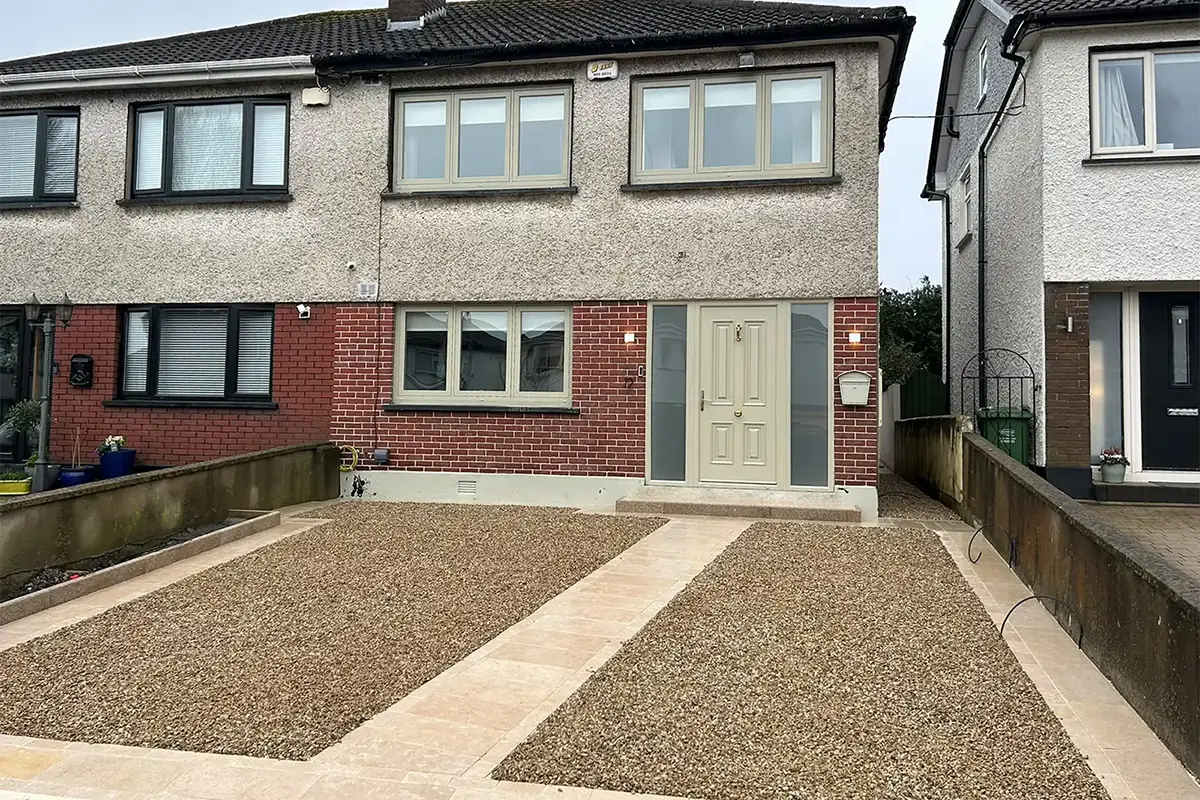
A Gravel Driveway Example in Monalea Grove, Firhouse
At our Monalea Grove gravel driveway project, the old worn and discoloured concrete surface was removed before a new sub-base was installed.
The driveway was framed with natural stone paving and blocks, with granite risers defining a planting area. A natural stone pathway led to a coordinating granite step.
The completed installation shows how the gravel surface can be designed alongside paths, entrance details and planting. Those surrounding features contribute to the result as much as the chosen stone.
How Much Maintenance Does Gravel Need?
Loose gravel needs some ongoing attention. Stones may need redistributing, leaves and debris need removing, and displaced material should be returned from adjoining paths or edges.
Check occasionally for uneven areas and changes in the driveway’s condition. Repeated depressions or movement deserve assessment rather than simply adding more stone each time.
Read our gravel driveway maintenance guide for practical advice on keeping the surface tidy.
If you prefer a bound surface, our gravel versus resin comparison explains the differences to consider.
How Does Gravel Choice Affect the Price?
Driveways 4 You’s gravel driveway guide range is €40–€70 per m², including site preparation, standard sub-base build-up and compaction, selected gravel and installation labour.
Using that range, a 50m² driveway gives an indicative budget of €2,000–€3,500. This is a budgeting example rather than a fixed quotation.
The final price depends on the site, preparation, drainage, access, selected gravel and design. Paving bands, decorative borders and granite kerb edging are quoted separately on-site.
See our 2026 gravel driveway price guide for further examples and details to check in your quotation.
Your Gravel Selection Checklist
- Confirm that the exact product is suitable for driveway use.
- Check its shape and stated stone grading.
- Compare a physical sample beside your home.
- View the stone wet and dry.
- Plan edging, paths and planting boundaries.
- Discuss slopes, turning areas and pedestrian access.
- Confirm preparation and drainage requirements.
- Check the complete installation scope in your quotation.
Choose Your Gravel Driveway With Driveways 4 You
We install gravel driveways across Dublin and surrounding areas, with work carried out by our own experienced team.
During your free site visit, we can assess the existing driveway and discuss stone finishes, layout, paths and edging before providing a quotation for the proposed work.


 CHAT

