
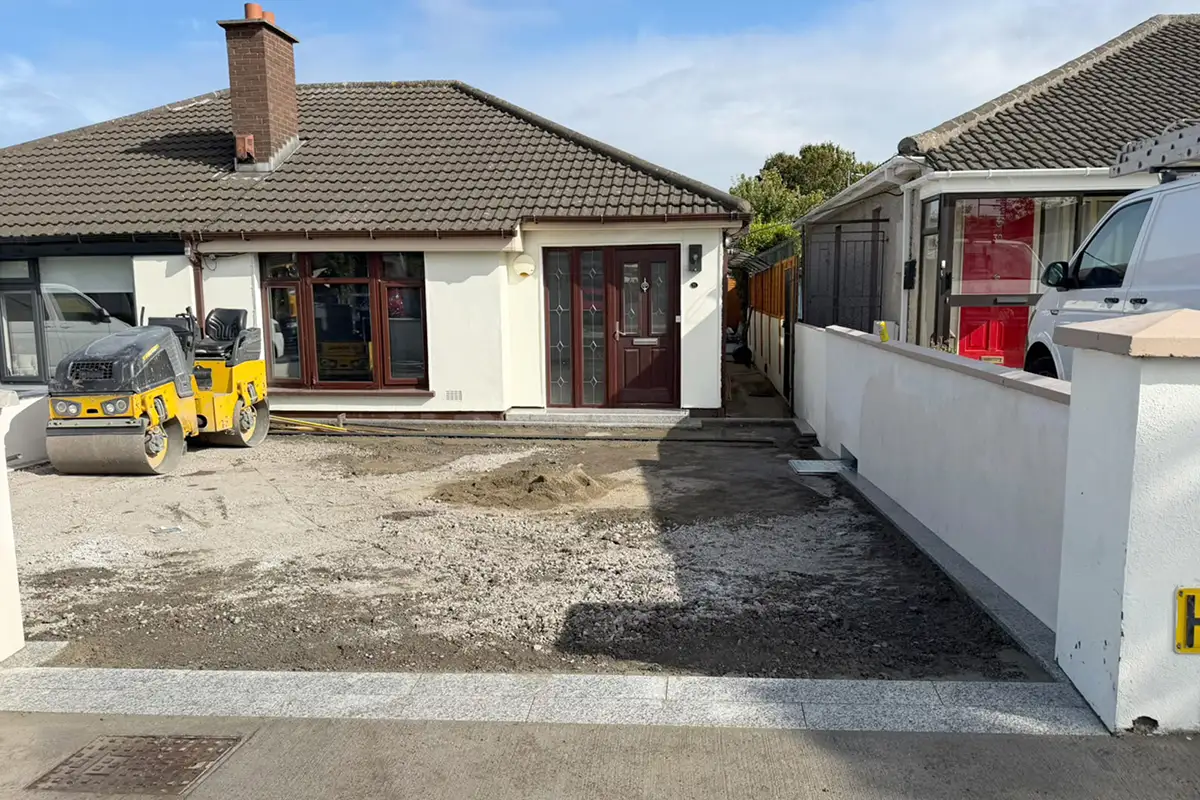
Effective driveway drainage starts with the complete design, not simply the addition of a drain. Surface falls, channels, foundations and the intended destination of rainwater need to work together. This guide explains the main considerations and what to discuss before installing a new driveway.
Where Will the Rainwater Go?
This is one of the most useful questions to ask during a driveway assessment. The proposed design should explain how water will move across or through the construction and where it will go next.
A visible drainage channel is only one component. Its outlet and the onward drainage arrangement also need to be considered.
Before agreeing the installation, ask for an explanation that relates to your property, including entrances, existing drains, adjoining paths and surrounding ground levels.
Driveway Drainage Terms Explained
| Term | What It Means | What to Ask |
|---|---|---|
| Falls | The planned slope of the finished surface. | Which direction will water travel? |
| Channel drain | A linear drain that collects surface water. | Where does it discharge, and how can it be maintained? |
| Outlet | The point where collected water leaves the channel or drainage component. | What onward drainage arrangement is proposed? |
| Infiltration | Water passing into the surrounding ground. | Has the ground's suitability been assessed? |
| Permeable construction | A designed system allowing water into and through its specified layers. | How do the surface, foundation and discharge arrangements work together? |
Why Driveway Falls Matter
Suitable falls guide water towards the intended collection or drainage points. They need to be planned alongside the levels of doorways, garages, paths and borders.
There is no universal slope that this article can prescribe for every driveway. The chosen surface, site layout and drainage design need to be considered together.
During the site visit, point out any places where water currently collects or flows towards an entrance. Photographs taken after rain can help explain the existing behaviour.
What Does a Channel Drain Do?
A channel drain collects water along a line in the surface. Its position, capacity, loading suitability, outlet and supporting installation all form part of the specification.
Ask where the collected water will go. A channel without a suitable onward arrangement does not complete the drainage design.
Also ask how the channel and any accessible silt collection points will be cleaned. Maintenance access should be considered before the driveway is finished.
Does Water Always Need a Soakaway?
No single drainage arrangement suits every property. Infiltration may be considered where ground conditions and the proposed design make it appropriate; other sites may need a different solution.
A soakaway should not be assumed suitable simply because there is space for one. Ask what assessment is required and who will confirm its location, capacity and suitability.
Any connection to an existing drainage system also needs to be checked. The proposal should identify the intended destination rather than rely on an unidentified pipe or gully.
A Permeable Surface Is Only Part of the System
Some paving systems allow water through the surface, but their drainage performance depends on the specified construction beneath it.
For example, permeable block paving uses suitable joints, bedding and sub-base materials as part of a coordinated system. Ordinary paving should not be assumed to perform in the same way.
When a quotation describes a driveway as permeable, ask for the complete build-up and water-management arrangement to be explained.
Drainage Across Different Driveway Surfaces
| Surface | What to Confirm |
|---|---|
| Tarmac | The proposed surface specification, falls, collection points and onward drainage. |
| Resin-Bound | The surface and supporting base specification, and how water is managed through the complete construction. |
| Block Paving | Whether the design is conventional or a specified permeable system, including the joints and foundation. |
| Gravel | The stone, underlying construction, ground conditions and any additional drainage requirements. |
The material name alone does not confirm how the finished driveway will drain. Compare the proposed construction and site design as well as the visible surface.
Foundations and Surface Levels Need to Work Together
Drainage planning should be coordinated with the foundation and finished levels. Ask how the proposed construction relates to existing thresholds, steps, walls and adjoining surfaces.
If the current driveway has settled, the assessment should establish whether that movement affects the drainage layout. A new surface should not simply reproduce an existing low spot.
Our guide to driveway settlement and sub-base preparation explains why unevenness needs its underlying cause assessed.
Real Example: Oak Court Lawn, Dublin 20
Our Oak Court Lawn tarmac driveway project involved replacing an old concrete driveway and lawn.
The existing materials were removed before the ground was prepared. Suitable slope levels were established and drainage was added as part of the preparation for the new driveway.
A granite block frame and natural granite entrance step were incorporated before the fine SMA tarmac finish completed the installation.
The project photographs show the preparation and finished appearance. The drainage work was part of the overall installation, rather than a separate feature considered after surfacing.
What If Your Existing Driveway Holds Water?
Record where the water collects, whether it follows every shower or only prolonged rain, and how long it remains. Note whether the behaviour has changed recently.
Check accessible grates for obvious leaves or debris, but do not assume a blockage is the only possible cause. Surface levels and the onward drainage arrangement may also need assessment.
Useful information to provide includes:
- An overall photograph of the driveway
- Photographs showing the water after rain
- The position of visible drains and channels
- Any recent surface movement or building work
- Whether water approaches a doorway, garage or boundary
What Should Your Quotation Explain?
Before accepting a new driveway quotation, ask for clarity on:
- Existing drainage: what has been identified and assessed?
- Finished levels: how will the driveway meet entrances and adjoining surfaces?
- Water movement: where will rainwater travel?
- Collection: are channels or other drainage components proposed?
- Destination: where will collected water discharge?
- Construction: what surface and foundation system is specified?
- Responsibilities: who will confirm any necessary design checks or approvals?
- Price: which drainage works are included or separately quoted?
- Maintenance: what access and care will be required?
If an important part of the proposal is unclear, resolve it before installation begins.
Looking After Driveway Drainage
Keep accessible grates and channels clear of leaves and accumulated debris. Follow the maintenance instructions supplied for the installed components.
After heavy rain, note persistent pooling or changes in how the driveway drains. Report damaged grates, movement around channels or water approaching an entrance.
Avoid washing oil, chemicals or collected driveway debris into drains. Seek appropriate advice when dealing with spills.
Planning a New Driveway?
Driveways 4 You considers preparation, levels, drainage and finishing details when assessing a new installation. Our own experienced team carries out the work, with no subcontractors involved.
Explore our tarmac driveway service, resin-bound driveway options, block paving installations or gravel driveway finishes.
When arranging a site visit, let us know about any existing pooling, drainage concerns or planned changes to the entrance.




 CHAT

