
Keep your block paving driveway looking its best with regular sweeping, suitable cleaning and attention to the joints. This guide explains how to manage weeds, stains and seasonal care, plus the warning signs that need more than a surface clean.
What Maintenance Does Block Paving Need?
The main tasks are removing debris, cleaning when necessary, keeping drainage clear and checking that the joints remain in good condition. Inspect the driveway periodically for loose blocks, damaged edges or areas that have become uneven.
The right care depends on the paving material and installation system. Concrete blocks, clay paving and natural stone can have different cleaning requirements. Sand-filled, permeable and mortar-jointed installations also need different treatment.
Before using a cleaning product or replacing jointing material, check what was installed and follow the paving manufacturer's guidance.
A Simple Block Paving Maintenance Routine
- Sweep regularly: remove leaves, soil and loose debris before they accumulate on the surface and in the joints.
- Remove small weeds early: deal with growth before it becomes established.
- Clean when needed: use a method suitable for the paving and its jointing system.
- Check the joints: look for gaps, missing material or damaged jointing.
- Keep drainage clear: remove debris from accessible channels and gullies.
- Inspect uneven areas: have rocking blocks, sinking or recurring puddles assessed.
How often you need to clean will depend on surrounding trees, shade, vehicle use and exposure to dirt. A sheltered driveway beneath trees may need more frequent attention than an open, sunny entrance.
How to Clean Block Paving Without Damaging It
Start with Dry Sweeping
Use a suitable outdoor brush to remove loose dirt and debris. Collect the material rather than sweeping it into drainage channels or neighbouring planting areas.
Avoid repeatedly digging into the joints with the brush or other tools, particularly where jointing material is already loose.
Choose a Suitable Cleaner
For general cleaning, check the paving manufacturer's recommended method. If a cleaning product is required, make sure it is suitable for the particular paving material, finish and any existing sealer.
Test the method on a small, inconspicuous area first. Follow the product's dilution, application and rinsing instructions, and protect nearby surfaces and planting as directed.
Do not assume that an acid-based patio cleaner or a household cleaning mixture is suitable for every type of block paving.
Check the Surface After Cleaning
Once the paving is clean and dry, inspect the joints, edges and any previously stained areas. Cleaning can make existing gaps or damage easier to see.
If jointing material has been displaced, arrange for it to be replenished with the correct material for the installation.
Can You Pressure Wash Block Paving?
Pressure washing is not always necessary for routine cleaning. Used incorrectly, it can damage the paving finish or remove material from the joints.
If the manufacturer permits pressure washing, follow its instructions for pressure, nozzle type, working distance and technique. Test a small area before cleaning the whole driveway.
- Avoid concentrated, aggressive jets directed into the joints.
- Do not continue washing if the surface begins to mark or jointing material is being removed excessively.
- Take particular care around loose blocks, damaged edges and deteriorated joints.
- Inspect the joints afterwards and replace displaced material using the appropriate specification.
Repeatedly washing out the joints without restoring them is not a complete maintenance routine.
Why the Joints Between Blocks Matter
On conventional flexible block paving, jointing sand contributes to the interlock between neighbouring blocks. The joints are part of the installation, rather than simply gaps to make the paving look tidy.
Where the installation uses kiln-dried jointing sand, gaps may need topping up after cleaning or as the material settles. This should be done in suitable dry conditions using the specified jointing sand.
Do not use ordinary jointing sand on every paving system. Permeable paving commonly uses a specified jointing aggregate, while rigid installations may have mortar or another jointing compound. Using the wrong material can affect the intended performance.
If you are unsure which system your driveway uses, establish that before re-sanding or replacing damaged joints.
How to Manage Weeds, Moss and Algae
Remove Debris That Collects in the Joints
Wind-blown seeds can establish where soil and organic debris accumulate. Regular sweeping helps reduce this build-up, particularly along borders and in areas beneath trees.
Weeds appearing in the joints do not, by themselves, prove that the whole driveway foundation has failed.
Remove Small Weeds Carefully
Small weeds can often be removed manually with a suitable tool. Work carefully to avoid damaging the blocks or removing large amounts of jointing material.
Check the joints afterwards and address any gaps using the correct material for the installation.
Pay Attention to Shaded or Damp Areas
Moss and algae can develop where moisture and shade persist. Remove accumulated leaves, keep drainage clear and use a suitable treatment only where recommended for the paving.
If the surface has become slippery, address it promptly. Persistent standing water or repeated heavy growth may also warrant a closer look at drainage and surrounding conditions.
Removing Oil and Other Driveway Stains
Attend to spills promptly using a suitable absorbent material and a cleaning method recommended for the paving. Avoid spreading the spill across a larger area or washing contaminated liquid into drains.
For established stains, choose a product specifically suited to both the stain and the paving material. Test it first and follow the manufacturer's instructions.
Some marks may remain despite cleaning. Where appropriate, replacing an individual stained block may be an option, although replacement units can differ in colour from weathered paving.
Does Block Paving Need Sealing?
Sealing is not a universal requirement for all block paving. Its suitability depends on the product, the installation system, the desired finish and any previous treatment.
A sealer may change the appearance of the paving and introduce its own maintenance requirements. It should be compatible with the surface and must not compromise the intended drainage performance.
Before applying one, check the paving manufacturer's guidance. Sealing should not be used to conceal loose blocks, unstable groundwork or unresolved drainage problems.
A Seasonal Checklist for Dublin Driveways
Spring
- Clear debris left by winter weather.
- Check for uneven blocks, damaged edges and gaps in the joints.
- Assess any moss or algae before choosing a suitable cleaning method.
- Check that drainage features are clear.
Summer
- Use suitable dry weather for joint maintenance where the specified material requires it.
- Remove small weeds before they become established.
- Attend to vehicle spills and marks promptly.
- Inspect the surface after any substantial cleaning.
Autumn
- Sweep fallen leaves regularly.
- Keep channels, gullies and edges clear of debris.
- Watch for areas that remain damp beneath accumulated leaves.
Winter
- Monitor recurring puddles and slippery areas.
- Use winter maintenance products only in accordance with the paving manufacturer's guidance.
- Avoid striking the paving with sharp tools when clearing ice.
- Check for changes in the surface after cold weather.
When Cleaning Is Not Enough
A clean surface can still have a construction or drainage problem. Arrange an assessment if you notice:
- Rocking or loose blocks: movement underfoot or beneath vehicle wheels.
- Repeated settlement: an area that sinks again after previous attention.
- Persistent pooling: water collecting regularly in the same depression.
- Spreading joints: widening gaps or blocks moving out of alignment.
- Movement at the edges: borders or edge restraints becoming displaced.
- Widespread damage: several affected areas rather than a single isolated block.
Cleaning or topping up joints cannot correct every cause of movement. The bedding, foundation, edge restraints and drainage may need to be examined.
Can Individual Blocks Be Replaced?
One practical advantage of block paving is that individual units or localised sections can often be lifted and reinstated.
Where a small area has settled, the underlying cause should be established before the paving is relaid. Simply repositioning the blocks without correcting the problem may lead to the same issue returning.
The extent of work depends on the condition of the existing driveway. A local defect does not automatically require full replacement, but extensive movement needs a broader assessment.
Why Good Installation Makes Maintenance Easier
A driveway with stable groundwork, suitable levels and well-finished edges gives routine maintenance a sound starting point.
At Driveways 4 You, our block paving installations are completed by our own experienced team, with no subcontractors. We consider excavation, sub-base preparation, compaction, levels, drainage and finishing as part of the installation.
Explore our block paving driveway installations in Dublin to see the paving styles, colours and border options available.
See Our Scholarstown Block Paving Project
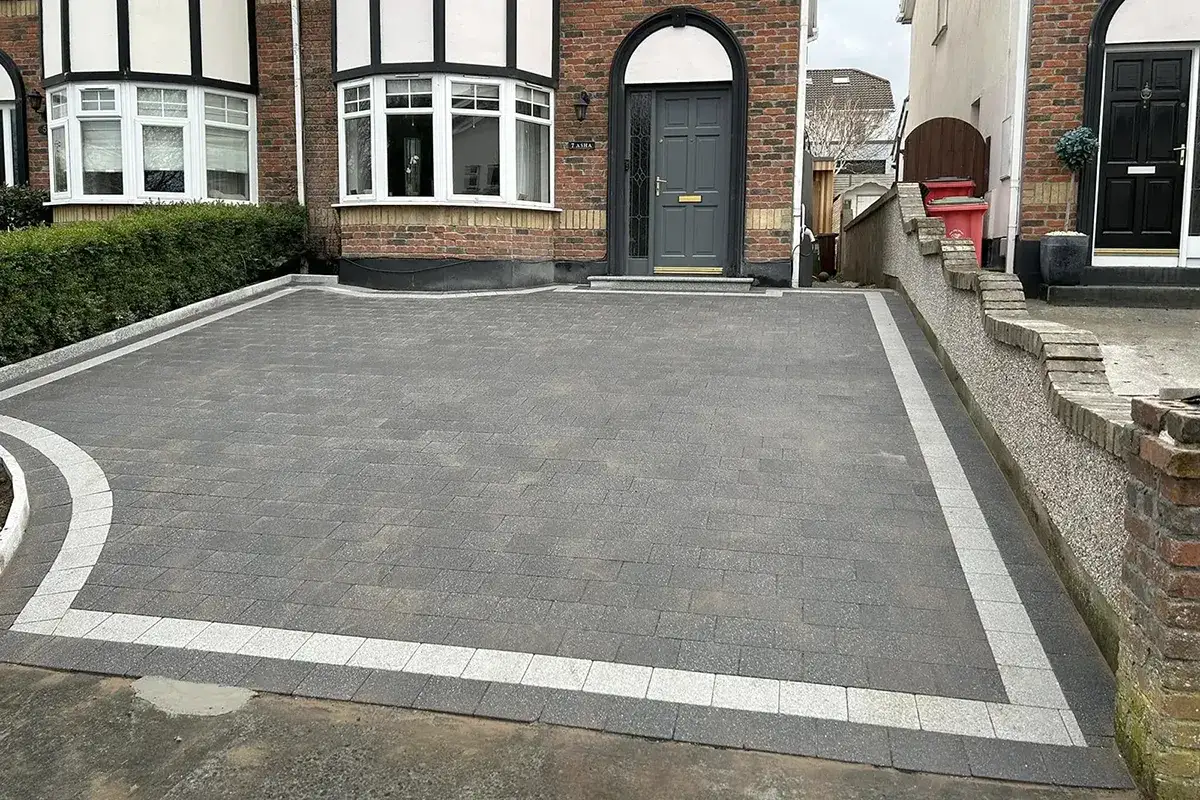
At a residential property in Scholarstown, Dublin, Driveways 4 You replaced an old concrete driveway with block paving featuring Kilsaran Black Corrib paving and a contrasting silver granite border.
The paving and border were selected to complement the period features of the home, with attention given to ground preparation, levels and the finished installation.
View the completed Scholarstown block paving project.
You can also browse our block paving project collection for examples of completed installations.
Planning a New Block Paving Driveway?
Regular care helps preserve an existing driveway. If you are planning a replacement, choosing suitable materials and getting the preparation right are equally important.
Driveways 4 You installs block paving driveways across Dublin, including Tallaght, Knocklyon, Rathfarnham and Clondalkin.
Contact our team to discuss your new driveway, paving choices and the preparation required for your property.

 CHAT

