
A driveway that sinks, spreads or becomes uneven needs its underlying cause assessed before the surface is replaced. Sub-base preparation, ground conditions, drainage and edge support can all affect performance. This guide explains what homeowners should look for and how proper preparation forms part of a new driveway installation.
Why Do Driveways Sink or Become Uneven?
Unevenness is a symptom rather than a diagnosis. A depression in a parking area, blocks moving apart and settlement beside an edge can involve different problems.
An unevenly settled or insufficiently compacted sub-base can allow movement under traffic. Drainage and the support around paving edges also need attention.
A site assessment should establish what has moved and whether the problem is localised or affects a wider area. Photographs help explain the symptoms, but they cannot confirm the condition beneath the surface.
What Is a Driveway Sub-Base?
The sub-base is a prepared foundation layer beneath the upper driveway construction. It is separate from the visible paving, resin or tarmac finish.
For homeowners comparing quotations, the important questions are what construction is proposed, why it suits the ground and intended use, and how it will be installed.
A description such as “new base” is less useful than a quotation that identifies the material, proposed compacted depth and preparation involved.
Signs Worth Having Assessed
| What You Notice | What to Ask During an Assessment |
|---|---|
| A dip in the parking area | Which construction layer has moved, and how extensive is the affected area? |
| Paving blocks spreading apart | Are the edges, joints and underlying construction providing suitable support? |
| Water collecting after rain | Are the levels, falls and drainage arrangements working as intended? |
| Movement beside a drain or service trench | Does the construction around that feature need investigation? |
| Repeated movement after previous work | Was the underlying cause identified and addressed? |
Why Compaction Matters
Placing foundation material and compacting it are separate parts of the work. The installation needs to follow a suitable method for the material, equipment and construction specified.
Ask how the contractor will prepare and compact the foundation. Avoid judging the finished result solely by how tidy the exposed aggregate looks in a photograph.
There is no single excavation depth or number of compactor passes that can be prescribed for every driveway through a general homeowner article. The proposed construction should reflect the site and selected surface system.
Levels, Falls and Drainage
Suitable surface falls and drainage help direct water away and protect the paving construction. They should be considered alongside the foundation rather than added after the layout has been agreed.
During the assessment, discuss doorways, garage entrances, adjoining paths and the connection with the public footpath. Ask where water is intended to go and what work is required to achieve that.
If pooling is new, record where it occurs and how long it remains after rain. This information can help the contractor assess changes in the driveway.
Edging Is More Than a Decorative Feature
For block paving, properly constructed edge restraints resist sideways movement. The visible border material is only part of that detail; its support and installation also matter.
If blocks have spread near the perimeter, ask for the edge construction to be checked. Repositioning the outer blocks alone may not address the reason they moved.
Granite frames and borders can also contribute to the appearance of a replacement driveway. Agree both their construction and their finished relationship with the new surface.
Do Weeds Mean the Foundation Has Failed?
Weeds alone do not establish that the sub-base has failed. Treat weed growth, widening gaps and uneven levels as separate observations to be assessed.
Tell the contractor whether the paving has visibly moved, when the gaps appeared and whether there are other symptoms such as pooling or loose edges.
For routine care of an otherwise sound paved surface, read our block paving maintenance guide.
Real Example: Bawnville Road, Tallaght
At our Bawnville Road driveway project in Tallaght, the existing cobblelock had become uneven and gradually spread apart. Weeds had established between the displaced blocks, making the entrance difficult to maintain.
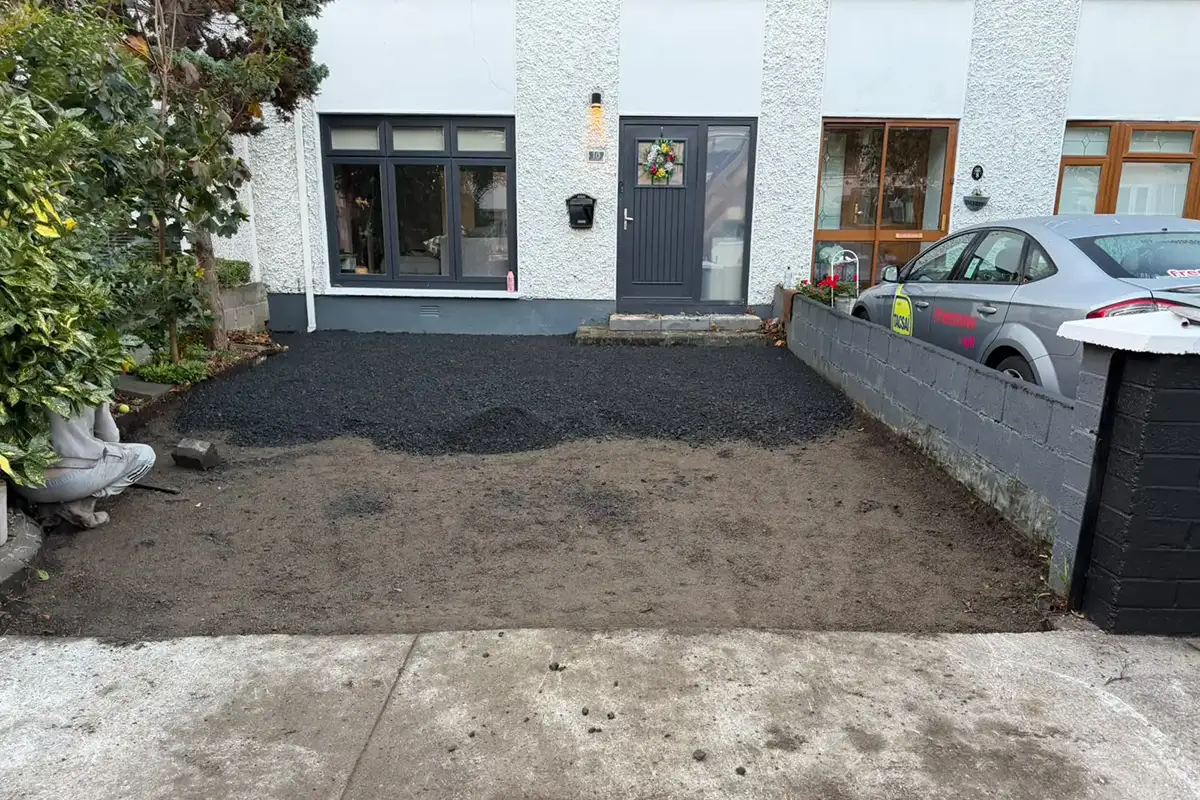
The old surface was removed before preparation began for the replacement driveway. The work included installing the sub-base and establishing suitable falls before laying the tarmac.
Silver granite blocks framed the driveway, with matching planting-area risers and a new granite entrance step. The preparation photograph and before-and-after images show the different stages of the transformation.
Real Example: Rathcurragh, Newbridge
Our Rathcurragh driveway installation in Newbridge also involved replacing uneven cobblelock where the previous foundation preparation had been inadequate.
The paving was removed, the sub-base corrected and the driveway falls established before the new tarmac was installed. Silver granite risers framed the existing planting area and complemented the granite surround.
These are examples of the work required on those particular properties. Another uneven driveway may need a different solution following assessment.
Does Every Uneven Driveway Need Complete Replacement?
No. The appropriate scope depends on the cause, extent of movement and condition of the remaining construction.
Ask the assessor to explain which areas are affected, what can reasonably be retained and why the proposed approach is suitable. Where complete replacement is recommended, the quotation should describe the excavation and foundation work involved.
For a new driveway from Driveways 4 You, we assess the existing surface, ground conditions, access, levels and proposed finish before setting out the installation scope.
What Should Your Driveway Quote Explain?
- Existing construction: what will be removed and what will be retained?
- Excavation: what preparation is proposed?
- Waste removal: how will excavated materials be handled?
- Foundation: what materials and compacted depths are specified?
- Surface: what paving or surfacing system will be installed?
- Edges: how will borders and restraints be constructed?
- Drainage: what falls and drainage works are included?
- Additional work: how will unforeseen ground conditions be discussed and priced?
A clear specification gives you a more useful basis for comparing quotations than the appearance of the proposed surface alone.
Planning a Replacement Driveway?
Driveways 4 You installs tarmac driveways, resin-bound driveways, block paving and gravel driveways, with work carried out by our own experienced team.
Our tarmac driveway cost guide and block paving price guide explain example budgets and the preparation included in our published ranges.
Contact us with your location, photographs and a description of the existing driveway to discuss a new installation.



 CHAT

