
Maintaining a gravel driveway involves removing debris, managing weeds and redistributing displaced stone. Occasional top-ups may also be needed, but persistent ruts or pooling should be assessed before more gravel is added. This guide explains practical care and what to check as your driveway is used.
How Do You Maintain a Gravel Driveway?
Start with the aftercare advice supplied for your installation. The gravel type, edging, foundation and any stabilisation system affect how the surface should be maintained.
Establish a simple routine: remove leaves and litter, check where stone has moved and inspect borders and drainage. Deal with small changes early rather than waiting until the driveway becomes difficult to use.
Gravel Driveway Maintenance Checklist
| Task | What to Look For | Suggested Action |
|---|---|---|
| Remove debris | Leaves, twigs, litter and accumulated soil. | Collect debris without removing unnecessary gravel. |
| Redistribute stone | Small ridges or areas where loose gravel has moved. | Gently rake the surface back into an even distribution. |
| Manage weeds | New growth around edges and within the surface. | Remove small weeds carefully and monitor recurring areas. |
| Inspect edging | Loose blocks, gaps or stone escaping at the boundary. | Ask for advice where the edge has moved or become damaged. |
| Check drainage | Blocked grates or persistent standing water. | Clear accessible debris and report recurring problems. |
| Assess top-up needs | Areas that remain thin after redistribution. | Confirm the suitable stone and quantity before ordering. |
Raking Displaced Gravel
Where loose stone has gathered into small ridges, use a suitable rake to redistribute it gently. Work across the visible surface without digging into the underlying construction.
Pay attention to parking and turning areas, where displacement may be more noticeable. Avoid pulling gravel onto paths, drains or the public footpath.
If your driveway contains stabilisation grids or another proprietary system, follow its maintenance instructions. Stop and seek advice if raking exposes components or underlying layers.
Removing Leaves and Garden Debris
Collect fallen leaves, twigs and litter before they become mixed through the gravel. Take particular care beside planting beds, hedges and sheltered corners.
Choose tools that allow you to lift debris without taking away large amounts of stone. Keep removed soil and garden waste out of the driveway when tending adjoining borders.
If using powered equipment, check its suitability and use it carefully to avoid scattering gravel towards windows, vehicles or people.
Managing Weeds
Remove small weeds carefully when they appear. Avoid pulling aggressively where roots are caught around edging or exposed parts of the construction.
Keep a record of areas where growth repeatedly returns. This can help you discuss the problem with your installer rather than treating every occurrence in the same way.
If considering a weed treatment, check that the product is suitable for the intended use and follow its label instructions. Take account of nearby planting and drainage.
Do not assume that visible weeds alone establish a failure in the driveway foundation.
When Does a Gravel Driveway Need a Top-Up?
Assess the surface after redistributing displaced gravel. Some areas may look thin because the stone has collected elsewhere rather than because more material is required.
If a top-up is needed, confirm:
- The existing stone type and source, where known
- The appropriate aggregate size and shape
- The area requiring additional material
- The intended finished surface depth
- Whether the underlying construction needs attention first
Adding too much loose gravel can change how the driveway feels underfoot and how easily it is used. Ask for advice rather than ordering by appearance alone.
Natural stone and supply batches can vary, so compare a sample before adding a different product to an established driveway.
Do Not Simply Fill Recurring Ruts
A small amount of displaced surface gravel is different from persistent settlement or a soft area beneath the driveway.
If a depression repeatedly returns after raking or topping up, have it assessed. Adding more stone may hide the symptom without establishing what is happening below.
Useful information to provide includes:
- Where the rut or depression appears
- Whether it changes after rain
- Which vehicles use the area
- How quickly it returns after redistribution
- Photographs showing the overall driveway and affected section
Our driveway settlement and foundation guide explains questions to ask before deciding on further work.
Check Borders and Edging
Inspect the perimeter for movement, damage or gaps where gravel is escaping. Note any changes around the entrance, paths and planting areas.
Do not build up the gravel above the intended edge level simply to conceal a gap. Ask whether the edging or adjoining construction needs attention.
Our guide to granite borders, steps and planting risers explains how these features fit into the overall design.
Keep Drainage Accessible
Keep visible drainage grates and accessible channels clear of leaves and stray stones. Remove loose debris carefully rather than washing it further into the system.
After rain, note any persistent pooling or changes in where water travels. Report repeated problems, particularly near entrances or areas showing movement.
A gravel surface should not be treated as proof that the complete driveway drains effectively. The underlying construction and ground conditions still matter.
Read our driveway drainage guide for questions about the complete water-management arrangement.
Oil and Other Spills
Contain a spill promptly and avoid spreading it by raking or washing it into drainage. Ask for advice on handling contaminated stone and any affected material beneath it.
Do not assume that covering a stain with fresh gravel resolves the contamination. The appropriate response depends on the substance and extent of the spill.
If a vehicle is leaking, address the source before carrying out surface maintenance.
Seasonal Checks
Use changes in the season as a reminder to inspect the driveway. After autumn leaf fall, clear debris and check drainage. Following prolonged wet weather, look for changes in levels or persistent soft areas.
When working around snow or ice, avoid scraping away gravel or damaging edging. Follow any winter-care advice supplied for the installation and adjoining materials.
Before garden or building work begins, discuss access and protection with the contractor so that soil, cement and other materials are kept out of the gravel.
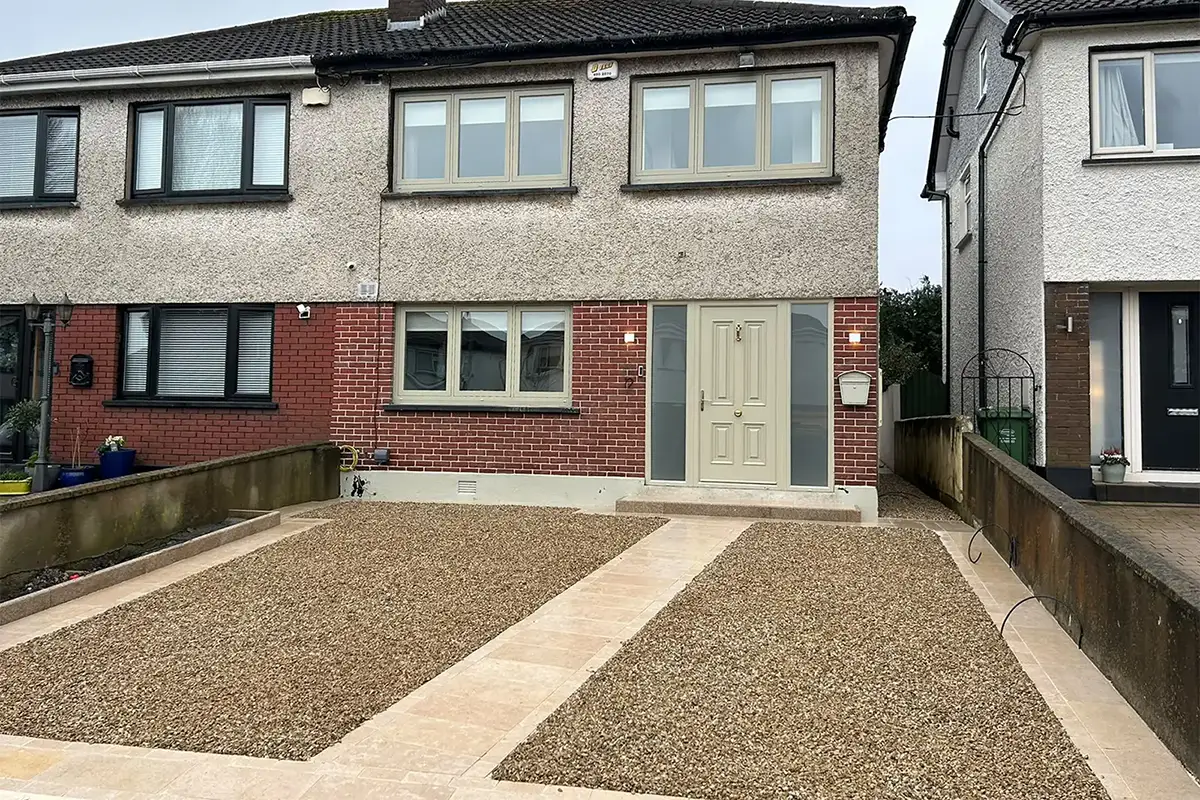
Real Example: Monalea Grove, Firhouse
Our Monalea Grove gravel driveway project replaced an old worn concrete surface with a newly prepared driveway.
The installation included a suitable sub-base, natural stone framing, granite planting-area risers and a natural stone pathway leading to a granite entrance step.
The project shows how a gravel parking area can be combined with defined paths and entrance features. When maintaining a similar layout, keep gravel within its intended area and check the adjoining edges and pedestrian routes.
Maintenance or a New Installation?
Routine raking and occasional top-ups are different from reconstructing a driveway. If the existing construction has widespread problems, first establish what work is needed.
Our published €40–€70 per m² gravel driveway guide relates to a new installation, including preparation, standard sub-base construction, the selected gravel surface and installation labour.
It should not be treated as a price for a gravel top-up or a repair. Read our gravel driveway cost guide for the installation scope and budgeting examples.
Is Gravel Still the Right Surface for You?
If the amount of routine upkeep no longer suits you, consider your access needs, parking layout and preferred appearance before choosing a replacement surface.
Our gravel versus resin driveway comparison explains differences in installation budgets, surface movement and everyday use.
A site discussion can help establish whether a new gravel installation or another surface would better suit the property.
Gravel Driveways From Driveways 4 You
Explore our gravel driveway finishes and installation service and completed gravel projects for design examples.
Our own experienced team carries out new installations, with no subcontractors involved. Existing customers can contact us with their project details and photographs for guidance on the driveway we installed.



 CHAT

